
Adapt vs. Adopt: What's the Main Difference?
-
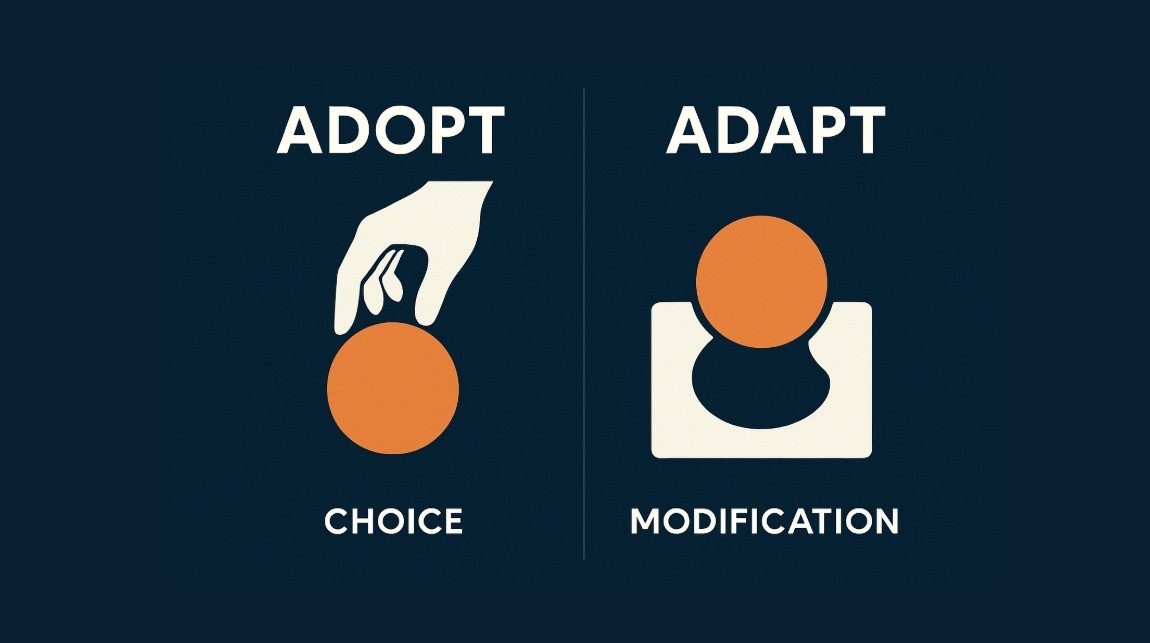
Adopt (verb): To choose, accept, or take something as your own (e.g., "The committee adopted the new resolution"). It implies selecting something from the outside and bringing it in without changing it.
-
Adapt (verb): To modify, adjust, or alter something to fit a new purpose or environment (e.g., "He adapted to the cold weather"). It implies a process of change to ensure survival or compatibility.
-
Adapt vs. Adopt:Adopt is about taking (ownership/choice); Adapt is about changing (modification/adjustment).
If you are looking for more writing tips, you can always browse our collection of academic guides, but for now, let's focus on these two confusing verbs.
What Is the Main Difference Between Adapt and Adopt?
The simplest difference is that adopt means to take something as your own, while adapt means to change something to fit a new situation.
To remember this instantly, use the "O vs. A" rule.
- Adopt has an 'O'. Think of Option or Ownership. You are choosing to take something.
- Adapt has an 'A'. Think of Alter or Adjust. You are changing something.
It’s a rough rule of thumb, but it saves lives (or at least grades) during finals week.
What Does "Adopt" Mean in Writing?
To adopt means to accept or choose something from the outside and bring it in, usually without changing it.
When you adopt, you are making a choice to accept a methodology, a pet, a child, or a bad habit, and making it yours. Think about it like this: You go to the shelter and adopt a dog. You don't build the dog from scratch or re-engineer it. You take the dog, bring it home, and now it’s your dog.
Key contexts for Adopt:
- Legally: Taking legal guardianship of a child.
- Research/Tech: Deciding to use a new software or framework (e.g., "The university decided to adopt Canvas as the new learning platform").
- Ideas: Accepting a philosophy (e.g., "I’ve adopted a minimalist lifestyle").
What Does "Adapt" Mean in Writing?
To adapt means to modify or adjust something (or yourself) so that it functions better in a specific environment.
It is a dynamic process of changing to survive or fit in. Biology majors, you know this one—it’s Darwinism. According to National Geographic's definition of adaptation, it is the process where an organism becomes better suited to its habitat. You don't "adopt" the cold weather; you change your wardrobe to handle it.
Key contexts for Adapt:
- Media: Turning a book into a movie (e.g., "They adaptedDune for the big screen").
- Methodology: Modifying a tool to do a job it wasn't made for.
- Environment: Adjusting to a new campus culture.
How Do I Use Adapt vs. Adopt in Research Questionnaires?
In academic research, you adopt a questionnaire if you use it exactly as written, and you adapt it if you change even a single word.
The team at Scifocus sees this error constantly in manuscript drafts. In the Methodology section of your thesis, this distinction is rigid:
- Adopting a Questionnaire: You take a survey (like the "Smith Anxiety Scale") and use it word-for-word. This preserves the original validity.
- Adapting a Questionnaire: You translate the survey, change "Dollars" to "Euros," or remove a question. The moment you tweak it, you have adapted it.
Pro-Tip: Be brutally honest about this in your paper. For more on citing adapted scales, check out the APA Style Blog’s guidelines, which are the gold standard for many students.
What Is the Difference Between Adapt, Adopt, and Adept?
Adept is an adjective describing a high level of skill, whereas adapt and adopt are verbs describing actions.
Just when you thought it was safe, English throws "adept" at you. It sounds similar, but it serves a totally different grammatical function.
- "She is adept at coding." (She is skilled at it).
- "She adopted a new coding style." (She chose a new one).
- "She adapted her code to work on mobile." (She modified it).
Do We Adapt or Adopt Technology?
Generally, organizations adopt technology (buy/choose it), while users adapt to it (learn/adjust to it).
In the tech world, Technology Adoption is a massive metric regarding how many people choose to use a product. But for the user—that's you—the struggle is usually adaptation.
Let’s say your university switches to Microsoft OneDrive.
- The University adopts OneDrive (they choose it and pay for it).
- You must adapt your workflow (learn where the buttons are and figure out why your formatting is broken).
How Do You Pronounce Adapt vs. Adopt?
Adopt is pronounced with a short 'o' sound (like "opt"), while adapt uses a flat 'a' sound (like "apt").
This might seem minor, but in an oral presentation or thesis defense, clear pronunciation prevents confusion.
- Adopt: Stress the second syllable. Uh-DOPT. (Rhymes with "Opt").
- Adapt: Stress the second syllable. Uh-DAPT. (Rhymes with "Trapped").
Still Not Sure? Let AI Do the Heavy Lifting
Look, English is tricky. Even if you know the rules, deadlines and caffeine jitters can make you doubt yourself. You don't want to lose points on a term paper because you "adapted" a policy instead of "adopting" it.
Why guess when you can know for sure?
At Scifocus, we specialize in helping researchers and students polish their writing to professional standards. Our AI-powered tools are designed to catch these exact kinds of contextual errors that standard spellcheckers miss.
Try the Scifocus Grammar Checker for free today. It’s the smartest way to ensure your "adopts" and "adapts" are spot on.
Read Next:
If you found this helpful, check out our other quick guides to confusing academic terms:
- Dose vs. Dosage: Definition and Usage – Essential for med and bio students.
- Fewer vs. Less: How to Use Them Correctly – The mistake that drives grammar nerds crazy.
- Disc vs. Disk: Which Spelling is Correct? – Don't let a single letter wreck your technical writing.
Did you like this article? Explore a few more related posts.
Start Your Research Journey With Scifocus Today
Create your free Scifocus account today and take your research to the next level. Experience the difference firsthand—your journey to academic excellence starts here.