

Active vs. Passive Voice in Academic Writing
Introduction
Writing a strong essay in medicine or research is not only about ideas. It is also about sentence control. Many students and researchers overuse passive voice, which makes academic writing longer, weaker, and harder to read. In clinical reports, manuscripts, and reviews, this often reduces clarity. The key issue is simple: active voice usually improves precision, while passive voice should be used only when the focus must stay on the action or result.
1. Why Voice Matters in Academic Writing
1.1 Clarity affects reader trust
In scientific writing, readers want the main point fast. Active voice shows who did what. Passive voice often hides the actor and adds extra words. For medical students, doctors, and researchers, that can blur meaning.
For example, compare these two sentences:
- Active: We analyzed the samples.
- Passive: The samples were analyzed.
The first sentence is shorter and direct. The second may still work, but it weakens the sense of responsibility and slows reading. In an essay, this difference can affect how professional the text feels.
1.2 Passive voice is not always wrong
Passive voice is still useful in some academic contexts. It can fit sections where the actor is less important than the process or result. In many journals, Materials and Methods often includes passive constructions because the method itself matters more than who performed it.
That said, modern medical and scientific writing usually prefers active voice in most sections. Use passive voice with intention, not by habit. If you can name the researcher, clinician, or team, active voice is often the better choice.
2. When to Use Active Voice
2.1 Use active voice for results and arguments
Active voice works well when you want to show reasoning, interpretation, or contribution. It is especially useful in Introductions, Results, Discussion, and Conclusions.
Examples:
- We found that blood pressure increased after treatment.
- The study demonstrated a clear association between smoking and lung damage.
- Our analysis showed improved accuracy in the final model.
These sentences are clearer because the subject is visible. The reader immediately knows who observed, tested, or concluded. In an essay, this helps build authority and flow.
2.2 Active voice reduces unnecessary word count
Wordiness often comes from passive structures. That matters in academic abstracts and concise journal writing. For example:
- Passive: It was observed that the patients responded quickly.
- Active: We observed that the patients responded quickly.
The active version removes extra words and keeps the sentence tight. This is valuable for manuscript drafting, thesis chapters, and conference summaries. Short, direct sentences usually read better and sound more confident.
2.3 Active voice supports accountability
In medicine and research, accountability matters. Active voice makes authorship and responsibility visible.
Examples:
- We collected the data.
- The team reviewed the pathology slides.
- The clinicians documented adverse events.
This style is especially useful when describing your own work. It makes the process transparent and easier to evaluate.
3. When Passive Voice Still Has Value
3.1 Use passive voice when the actor is unknown or unimportant
Sometimes the performer is not the point. In those cases, passive voice is acceptable.
Examples:
- The blood samples were stored at 4°C.
- The questionnaire was distributed online.
- The tissue sections were stained with hematoxylin and eosin.
These sentences work because the method is the focus. In a lab protocol or clinical procedure, passive voice can keep the emphasis on the process.
3.2 Use passive voice to keep emphasis on the object
Passive voice can help when the object deserves priority. This is common in Results sections.
Example:
- The biomarker was elevated in the treatment group.
Here, the biomarker is the main topic. The sentence keeps attention on the finding. That can be useful in an essay or research report when the data point matters more than the researcher.
3.3 Do not mix styles without reason
A common problem is inconsistency. One paragraph uses active voice. The next suddenly shifts into heavy passive voice. That creates a disjointed tone.
Choose a dominant style for each section.
- Introduction: mostly active
- Results: active, with selective passive
- Methods: often passive
- Discussion: mostly active
Consistency matters more than rigid rules. Editors and readers notice stable, controlled writing.
4. Common Writing Mistakes to Avoid
4.1 Do not let non-human subjects perform human actions
A frequent problem in academic writing is personifying objects.
Incorrect:
- The results found that...
Better:
- We found that...
- The results showed that...
Results do not “find” anything. Researchers do. This is a basic but important rule. It improves accuracy and credibility.
4.2 Avoid vague pronouns and unclear references
Passive voice often increases ambiguity. So do unclear pronouns.
Weak:
- It showed that they improved.
Better:
- The trial showed that the patients improved.
In a medical essay, unclear references can confuse readers and weaken your argument. Use the full noun when needed.
4.3 Avoid grammar habits that reduce precision
Academic writing problems are not limited to voice. Writers also struggle with comma misuse, subject-verb agreement, and confusing word choice. Passive voice often makes these issues harder to spot.
A practical checklist helps:
- Keep one main idea per sentence.
- Match singular subjects with singular verbs.
- Use the exact noun when the pronoun may confuse meaning.
- Proofread for words that look similar but mean different things.
- Define abbreviations the first time you use them.
Good voice choice is part of overall sentence hygiene.
5. How to Improve Voice in a Medical or Research Essay
5.1 Rewrite passive sentences into active ones
A simple revision method can improve most drafts.
Start with the passive version:
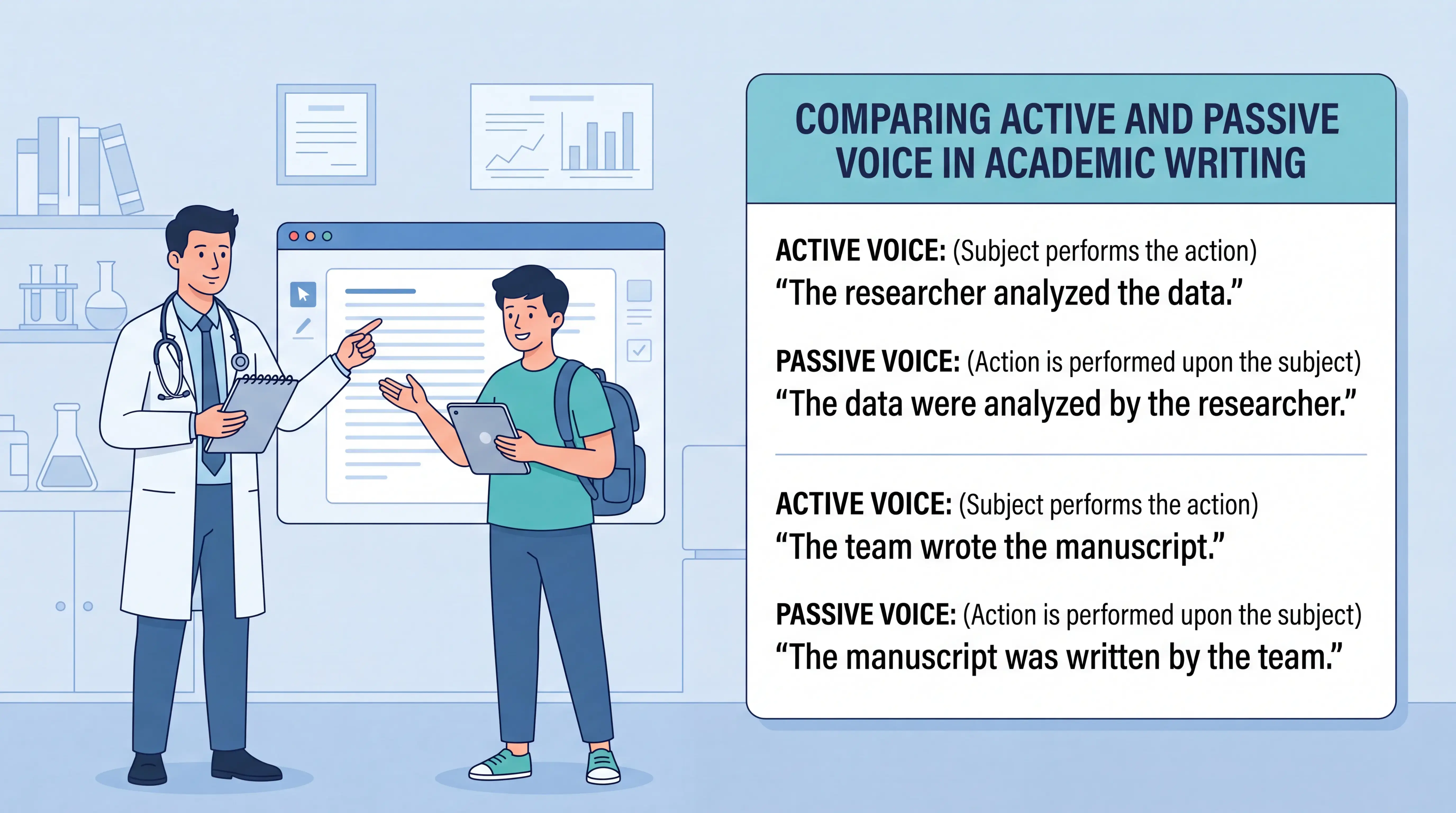
- The data were analyzed by the team.
Rewrite it:
- The team analyzed the data.
Start with:
- A correlation was observed between inflammation and severity.
Rewrite it:
- We observed a correlation between inflammation and severity.
This method is fast. It is also practical for busy clinicians and researchers who need clean drafts before submission.
5.2 Match voice to section purpose
Each part of an academic paper has a different job.
- Introduction: explain the problem and rationale.
- Methods: describe how the work was done.
- Results: report findings clearly.
- Discussion: interpret the meaning.
- Conclusion: summarize the main takeaway.
Active voice usually strengthens explanation and interpretation. Passive voice can still support procedural detail. The best academic writing uses both strategically, not randomly.
5.3 Use tools that speed up revision
Many researchers lose time fixing sentence-level problems manually. That is where a writing tool can help. scifocus.ai supports faster drafting and revision for academic users who need clearer, more polished scientific English.
For medical students, doctors, and researchers, that means less time on mechanical edits and more time on content quality. It can help you refine sentence structure, improve readability, and reduce passive-heavy wording in your essay or manuscript. If you want a cleaner workflow before submission, scifocus.ai is worth trying.
Conclusion
Active voice usually makes academic writing clearer, shorter, and more confident. Passive voice still has a place, especially in Methods or when the actor is not important. For a strong essay, the goal is not to eliminate passive voice completely. The goal is to control it. Write with purpose. Keep your subject clear. Choose the structure that best serves the reader. And if you want faster, more efficient revision, explore scifocus.ai as a practical writing assistant for academic work.
Did you like this article? Explore a few more related posts.
Start Your Research Journey With Scifocus Today
Create your free Scifocus account today and take your research to the next level. Experience the difference firsthand—your journey to academic excellence starts here.