

From Topic Selection to Citation: A Complete Guide to Writing an Outstanding Biomedical Essay
Introduction
Writing a strong Essay in biomedicine is not just about good English. It is about choosing a focused topic, building a logical argument, and citing evidence correctly. Many medical students, doctors, and researchers lose time because their topic is too broad, their title is unclear, or their references are outdated. A well-structured Essay starts long before the first sentence is written.
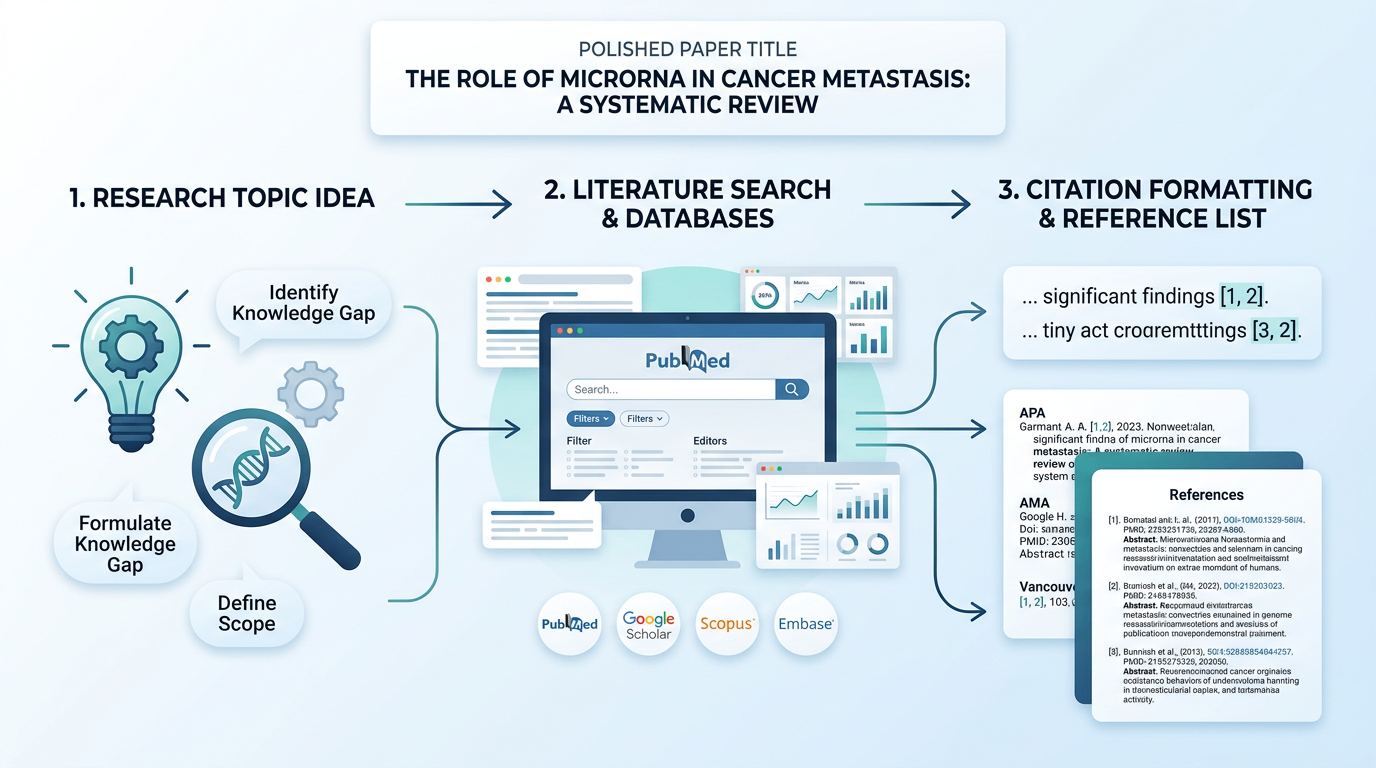
1. Choose a Topic That Can Be Written Well
1.1 Stay close to your expertise
A strong biomedical Essay begins with a topic you understand. If the subject is too far from your clinical or research background, you will spend too much time learning basics instead of writing well. That weakens depth and accuracy.
The knowledge base stresses one key point: the topic should be closely related to your research direction. This is especially important for medical students and clinicians who need a realistic scope. A familiar field also makes it easier to judge whether the literature is enough.
1.2 Pick a topic with active research value
A good topic should be relevant now. In biomedical writing, that usually means one of three things:
- a current hot area,
- a classic and still important issue,
- a clinically meaningful problem with ongoing debate.
For example, topics linked to cancer therapy resistance, pulmonary hypertension management, or fibrosis mechanisms are easier to support with recent literature. Avoid topics that are either too niche or too outdated to sustain a full Essay.
1.3 Narrow the angle early
Broad topics produce weak essays. Narrow topics produce depth. Instead of writing about “cancer,” choose a smaller angle such as a specific signaling pathway, biomarker, therapy resistance mechanism, or diagnostic technique.
A focused angle helps you answer a clear question. It also improves readability and search relevance. This is critical if your Essay is meant for academic review, publication support, or educational use.
2. Build the Essay Around a Clear Title
2.1 A title should be accurate, complete, and concise
In biomedical writing, the title is the first contact element. It must tell the reader what the paper is about without confusion. The course material emphasizes three requirements: accuracy, brevity, and focus.
A weak title is usually vague, too long, or detached from the actual content. That creates problems for indexing and for reader trust.
A good title should reflect the core research object, method, or conclusion. It should avoid empty phrases and unnecessary words. If the title does not help a reader predict the content, it is not strong enough.
2.2 Use keywords, verbs, and main conclusions
A practical title strategy is simple:
- List the core keywords.
- Include the necessary research context.
- Add a verb if the title style requires one.
- Reflect the main conclusion when appropriate.
- Use common scientific vocabulary.
- Revise repeatedly.
This approach comes directly from the course outline. It works because it forces clarity. For example, a title that names the disease, the molecule, and the mechanism is usually more useful than one that only sounds academic.
2.3 Avoid common title mistakes
Many biomedical titles fail for predictable reasons:
- no real meaning,
- too abstract,
- mismatch with the article content,
- unclear logic,
- wrong word order,
- omitted information,
- poor structure,
- unexplained abbreviations.
Do not use abbreviations unless they are universally known in the field. Readers and search engines both need clarity. A title should be understandable on first reading.
3. Prepare the Literature Before You Write
3.1 Collect evidence in three layers
A biomedical Essay needs more than a few random papers. The knowledge base recommends preparing literature in stages:
- conceptual papers,
- mechanism-related papers,
- solution or application papers.
This structure helps you move from background to analysis to practical significance. It also prevents your essay from becoming a list of studies without a clear storyline.
3.2 Mix classic and recent studies
A credible Essay should not rely only on old papers or only on the latest publications. Classic studies provide the foundation. Recent studies show that the issue is still active.
For most biomedical topics, a balanced reference set is stronger than a large but unfocused one. Use recent papers to support current mechanisms, and classic papers to anchor the field.
3.3 Organize references before drafting
Good writing depends on good organization. Create folders by theme, pathway, disease, or method. Build a simple outline file with key points under each section.
This saves time during drafting and revision. It also makes it easier to detect gaps in logic. If you cannot place a paper into a clear section, it may not belong in the essay.
4. Structure the Biomedical Essay for Clarity
4.1 Start with the clinical or scientific problem
The introduction should do three things. It should define the disease or biological question, explain why it matters, and point to the unresolved gap. In biomedical writing, this usually means epidemiology, current management, and limitations of existing approaches.
A strong opening does not try to explain everything. It explains enough to justify the topic. The best introductions move from broad context to specific gap in a controlled sequence.
4.2 Keep the body logically progressive
The main body should not jump between unrelated points. A strong Essay usually follows this order:
- background and significance,
- current evidence,
- mechanism or method discussion,
- limitations,
- future direction.
This structure works for both review-style and argument-driven biomedical essays. Each paragraph should have one job. If a paragraph tries to do too much, the reader loses the thread.
4.3 End with a precise conclusion
The conclusion should not repeat the whole essay. It should summarize the main point and show why it matters. In biomedical writing, that often means linking the core mechanism or clinical issue back to diagnosis, prognosis, therapy, or research design.
A good conclusion is specific, not decorative. It should leave the reader with a clear takeaway and a realistic next step.
5. Write with the Standards of Biomedical Research
5.1 Be precise about methods and evidence
Biomedical readers expect precision. If you mention experiments, datasets, or clinical samples, describe them clearly. If you reference a mechanism, name the pathway or biological process. If you discuss a method, explain why it matters.
The provided knowledge base repeatedly emphasizes this principle in different contexts. Whether you are writing a review, a research summary, or a mechanism-based essay, vague language weakens trust.
5.2 Use mainstream scientific terms
Avoid overly creative wording. Biomedical writing values standard terminology because it improves searchability and reduces misunderstanding. Use the vocabulary that researchers in the field already use.
That includes disease names, pathway names, experimental methods, and diagnostic terms. Mainstream wording is especially important for title writing and abstract-style summaries.
5.3 Keep the argument evidence-based
If you make a claim, connect it to a study, review, or guideline. Do not overstate causality when the evidence only shows association. Do not claim clinical applicability if the data are still preclinical.
E-E-A-T in biomedical writing depends on controlled claims and transparent evidence. Readers trust essays that are careful with interpretation.
6. Build Strong Citations and Avoid Reference Problems
6.1 Citations are part of the argument
Citations are not decoration. They are how biomedical writing shows traceability. Every major claim should point to a reliable source. This is essential for trust, especially when the audience includes clinicians and researchers.
A well-cited Essay demonstrates that the author knows the field and has checked the evidence carefully. Poor citation practice makes even strong content look weak.
6.2 Use current and relevant sources
When possible, update old references with recent studies. The course material recommends checking PubMed and using newer literature, especially from 2020 onward when appropriate. This helps avoid outdated framing.
Recent sources are also more likely to reflect current methods, consensus, and clinical direction. However, do not remove classic papers if they are foundational.
6.3 Match citation style carefully
Different journals and institutions require different citation styles. Before submission, confirm the format, numbering rules, and reference order. If the style is inconsistent, it reduces professionalism immediately.
A practical workflow is:
- Draft the essay with placeholder citations.
- Verify every source.
- Update old or weak references.
- Check formatting in the final version.
That process reduces errors and saves revision time.
7. Common Biomedical Essay Mistakes to Avoid
7.1 Weak scope and vague wording
The most common problem is a topic that is too broad. Broad scope leads to shallow content. Vague wording then makes the argument harder to follow.
If your reader cannot quickly identify the question, the essay needs revision.
7.2 Title-content mismatch
Another frequent mistake is a polished title with a weak body. This happens when the title promises a specific mechanism, but the essay only provides general background.
The title must match the evidence and the actual depth of the article.
7.3 Poor literature selection
Using only a few easy-to-find papers is not enough. Good biomedical writing needs both depth and balance. It should include classic studies, recent findings, and sources that directly support the central thesis.
7.4 Unclear logic
Some essays fail because the paragraphs are individually correct but structurally disconnected. Use transitions that show why the next point follows from the last. Readers should never guess the logic.
8. How scifocus.ai Can Help You Write Faster and Better
8.1 Reduce friction in topic development
Writing a biomedical Essay often fails at the earliest stage. The topic is unclear, the title is weak, and the outline is unstable. This is where a structured writing tool can help.
scifocus.ai can support the early planning stage by helping you organize ideas, build outlines, and keep the topic focused. For busy medical students, doctors, and researchers, that means less time lost in the blank-page stage.
8.2 Improve drafting, clarity, and citation workflow
A serious biomedical Essay needs precise language and well-managed references. A tool like scifocus.ai can help streamline drafting and structure, especially when you are turning scattered notes into a coherent academic piece.
It is not a substitute for expert judgment. But it can reduce repetitive work, improve efficiency, and help you move from raw material to a polished draft faster.
8.3 Support a more reliable writing process
The real value of a writing assistant is consistency. It helps you keep the topic narrow, the logic clear, and the references organized. For researchers under deadline pressure, that matters.
If your goal is to produce a stronger biomedical Essay with less friction, using scifocus.ai can be a practical part of your workflow.
Conclusion
A strong biomedical Essay is built step by step. Start with a topic that fits your expertise. Narrow the angle. Write a clear title. Prepare literature carefully. Keep the structure logical. Use precise language. Then verify citations with discipline.
If you want a faster and more organized workflow, consider using scifocus.ai to support topic planning, drafting, and reference management. The goal is not only to write more, but to write with accuracy, clarity, and academic trust.

Did you like this article? Explore a few more related posts.
Start Your Research Journey With Scifocus Today
Create your free Scifocus account today and take your research to the next level. Experience the difference firsthand—your journey to academic excellence starts here.