

From Literature Management to Data Analysis: A Complete Guide to Building Your Personal Research Toolchain
Introduction
If you are a medical student, physician, or researcher, you already know the real problem is not “doing research.” It is handling too many tasks at once: finding papers, organizing references, extracting data, running analysis, and keeping every result traceable. A well-designed research tool workflow solves this. It reduces repeated work, improves accuracy, and makes your research process easier to defend in writing and peer review.
1. Why a Personal Research Toolchain Matters
1.1 The real bottleneck is workflow, not effort
Many early-stage researchers spend hours copying citations, reformatting tables, or rechecking variables. That is inefficient. A strong research tool setup reduces these repeated steps and keeps your work consistent from the first search to the final manuscript.
In clinical research, this matters even more. A missed reference, an inconsistent study label, or a wrong effect size can affect the credibility of a paper. If your workflow is scattered, your analysis becomes harder to reproduce. That is a problem for publication and for collaboration.
1.2 A toolchain should support the whole research cycle
A good toolchain is not one app. It is a linked system. It should support:
- literature retrieval
- reference management
- note-taking and writing
- data extraction
- statistical analysis
- figure generation
- evidence checking
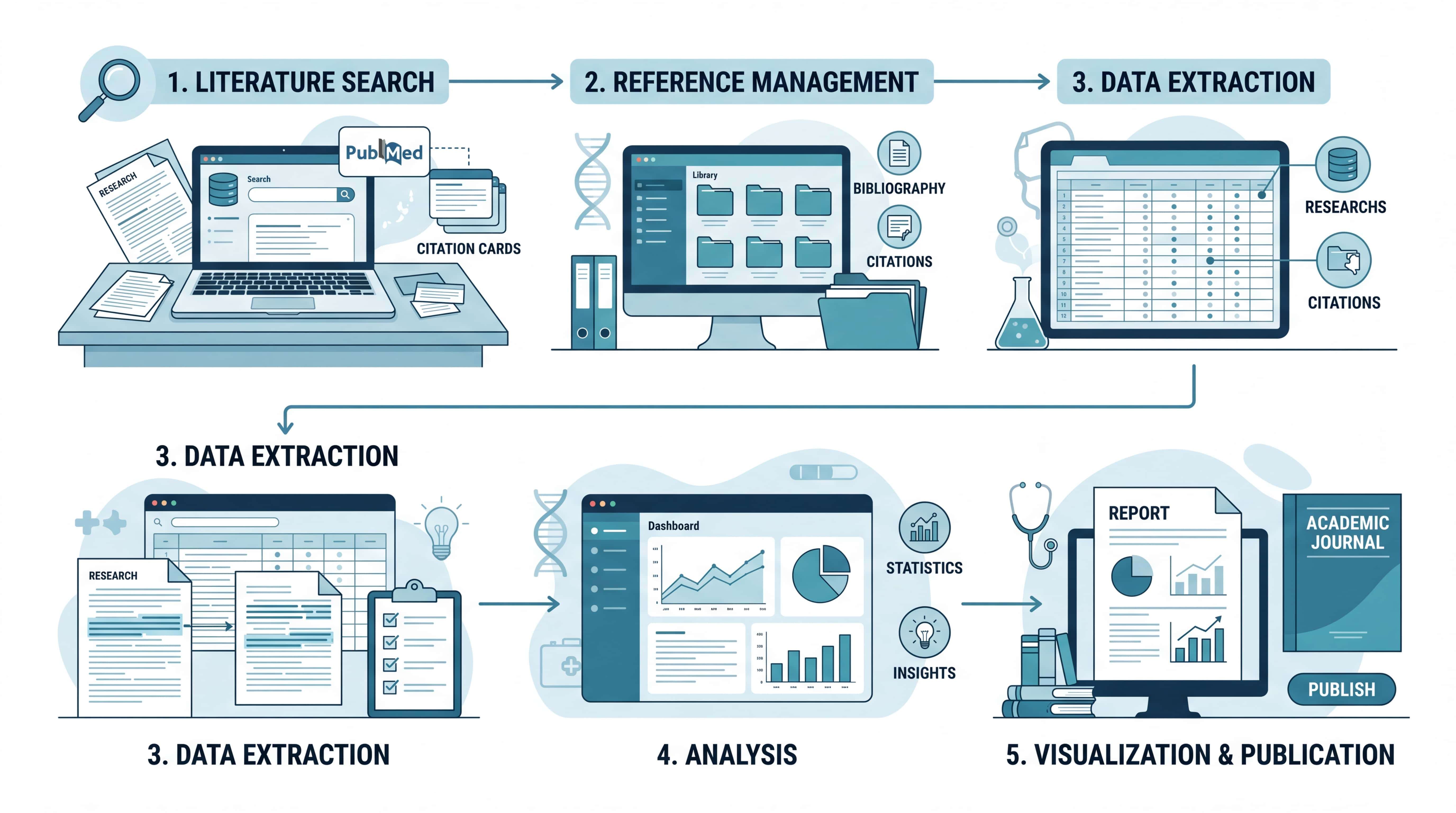
This is the core idea behind a modern research tool system. You do not need many tools. You need the right ones, arranged in the right order.
2. Start with Literature Management
2.1 Build a clean paper library
Before analysis begins, you need control over your literature. For clinical and biomedical topics, this means saving search results, screening studies, and storing full texts in a structured way. Tools that support multi-link downloading, tagging, and sorting by publication details can save substantial time.
The source material highlights a practical point. A useful platform should let you filter by impact factor, document type, and publication date. It should also help you access article links more efficiently. A well-organized literature library is the foundation of every reliable research tool workflow.
2.2 Extract only the data that matters
For review or meta-analysis, extracting the right fields is more important than collecting everything. At minimum, record:
- author and year
- study population
- intervention or exposure
- comparison group
- effect size type
- event counts and total sample size
- key outcomes
In the provided meta-analysis workflow, the focus is on extracting study information and grouping papers correctly before analysis. That structure reduces errors later. If your study labels are wrong, the statistical output will also be wrong.
3. Use Bibliometric and Reading Tools to Find Research Directions
3.1 Map the field before you write
If you are starting a new topic, you need to know where the field is heading. Bibliometric tools such as Citespace are useful here. They help visualize research hotspots, influential authors, and topic trends. This is valuable when choosing a thesis direction, identifying a clinical question, or preparing a review article.
The knowledge base notes an important principle: bibliometric analysis works best when the field has enough literature. In a very new area, there may be too few papers to build meaningful maps. Quantity matters, because bibliometric tools depend on a stable literature base.
3.2 Combine reading and discovery
A strong research tool setup should not stop at storing papers. It should also help you read faster and find supporting evidence. The source material mentions tools that support sentence-based literature searching, quick file location, and browser-based academic search. These functions are practical because they reduce context switching.
For medical learners and physicians, this is especially useful. When writing a discussion section, you often need one precise sentence to support one claim. Tools that help you locate the source faster can significantly improve writing efficiency.
4. Turn Raw Papers into Usable Data
4.1 Define the analysis type first
Before you enter data, clarify the analysis model. Are you working with binary outcomes, continuous variables, or survival data? Are the studies paired or unpaired? Are you comparing treatment versus control, or disease versus non-disease?
This step is essential because each data type requires a different setup. The meta-analysis demo in the source material shows that researchers must add comparison groups, name studies properly, and paste values into the correct fields. Good analysis begins with correct data structure, not with the software button you click first.
4.2 Keep extraction simple and auditable
When entering data, use a standard template. At minimum, include:
- study ID
- sample size
- event number or mean and standard deviation
- effect measure
- subgroup labels
- quality notes
This approach makes it easier to review errors later. It also improves reproducibility. If a co-author or reviewer asks how a number was obtained, you should be able to trace it quickly.
5. Choose the Right Analysis and Visualization Tools
5.1 Select the model based on heterogeneity
In meta-analysis, model choice should depend on heterogeneity. The source material emphasizes I² as the key indicator. In practice, fixed-effect and random-effects models are chosen based on the degree of inconsistency across studies.
You should also choose the correct effect measure. Common options include OR and RD for binary data. For consistency analysis, Mantel-Haenszel is often used. The best research tool is not the one with the most features. It is the one that helps you choose the right method and display it clearly.
5.2 Check bias and stability
A reliable analysis does more than produce one pooled result. It also checks:
- funnel plot asymmetry
- sensitivity analysis
- study quality
- risk of bias
These steps tell you whether the result is stable. The source material specifically mentions funnel plots and sensitivity analysis as part of the workflow. That is important because a clean result is not enough. It must also be robust.
5.3 Make figures readable
Figure quality affects paper quality. Forest plots, funnel plots, quality tables, and summary charts should be readable at manuscript size. Keep labels clear. Avoid overcrowding. Use consistent naming across all figures.
This is where a structured research tool chain pays off again. The data entry stage affects the final image quality. If your input is clean, your visual output will also be cleaner.
6. Add Writing and Project Management Tools
6.1 Writing should follow the workflow, not interrupt it
Writing becomes much easier when your notes, references, and analysis output are already organized. A practical writing tool should help you store outlines, draft sections, and insert citations without losing track of source papers.
The knowledge base also mentions note-taking and document systems that support markdown-style writing. That matters because structured notes are easier to search, revise, and reuse. For researchers, a simple text-based system often works better than a heavy, overly complex one.
6.2 Keep the toolchain minimal
Do not stack too many apps. That creates friction. Instead, use a small set of tools for:
- searching literature
- storing references
- extracting data
- analyzing results
- writing the manuscript
A lean research tool workflow is usually more sustainable than a crowded one. If every step has a dedicated purpose, you will waste less time switching between systems.
7. Where scifocus.ai Fits in the Workflow
7.1 Use one platform to reduce fragmentation
Many researchers struggle because their work is spread across multiple tabs and software windows. This leads to lost notes, duplicated files, and inconsistent versions. A platform like scifocus.ai can help centralize parts of the workflow, especially when you need a more efficient process for literature handling, writing support, and research organization.
The practical value is not “more tools.” It is fewer interruptions. If a tool helps you keep papers, notes, and drafting in one place, your workflow becomes easier to manage.
7.2 Support faster execution with less manual repetition
The best research tool is the one that saves time without reducing rigor. If scifocus.ai helps you organize information more efficiently, it can reduce manual copying and repeated searching. That matters for medical students preparing a thesis, doctors drafting a paper after clinic hours, and researchers handling multiple projects.
The goal is not to automate thinking. The goal is to remove avoidable friction so you can focus on the scientific question.
Conclusion
A strong personal research toolchain is built step by step: literature management, study extraction, model selection, bias checking, visualization, and writing. If each part is clean, the final manuscript becomes easier to produce and easier to defend. For medical students, physicians, and researchers, the smartest strategy is to build a system that is simple, traceable, and reproducible. If you want to streamline that process, try scifocus.ai and see how a more integrated research tool workflow can support your next project.

Did you like this article? Explore a few more related posts.
Start Your Research Journey With Scifocus Today
Create your free Scifocus account today and take your research to the next level. Experience the difference firsthand—your journey to academic excellence starts here.